Thursday, August 20, 2015

Broadband Infrastructure Grant Deadline September 15

During the 2015 special session, the legislature included $10,588,000 in funds for the Border-to-Border Broadband Infrastructure grant program. 


The application period is now open to apply for these grants to expand broadband service in unserved and underserved regions throughout Minnesota. The grants can provide up to 50 percent of project development costs. The maximum grant amount is $5 million. The deadline for applying is September 15.
Expressions of Interest: If you have reviewed the application information and concluded that you aren’t able to apply in the 2015 grant round—please let DEED know of your interest by filling out the Expression of Interest in Support of Minnesota Broadband Infrastructure Grant Program form. They have data on the number of unserved households but YOU can help them document the demand for broadband in unserved and underserved areas to support continuation of the broadband infrastructure grant program!
If you would like to be added to our email list for updates, sign-up at our Contact Us webpage.

Broadband and Precision Ag

Agriculture is an important industry in northwest Minnesota. The broadband needs of the Ag sector are critical. This short video, recorded at a recent meeting in Willmar with Senator Amy Klobuchar, highlights the Ag sector's growing need.

Senator Klobuchar Talks About Funding Broadband

Senator Klobuchar has been working on the issue of rural broadband. At a recent meeting in Willmar, she talked about developments that she and Senator Thune have been working on. The solution they are working on involves getting more money out of the Universal Service Fund to support broadband, without hurting local service providers.


Frontier Communications Discusses Broadband Issues

Senator Amy Klobuchar recently visited Wilmar Minnesota to discuss rural broadband issues. In this video, Frontier Communications highlighted some of the issues surrounding serving high-cost rural areas.


Wednesday, May 7, 2014

Lake of the Woods Outdoorsman Uses YouTube and Other Broadband Tools to Reach Global Market

Jean-Paul Tessier, Lake of the Woods Outdoorsman, 
and his retriever Rocky.

In less than two short years, Jean-Paul Tessier has built an almost larger-than-life persona for himself as the “Lake of the Woods Outdoorsman.”

After launching his business, Jean-Paul quickly learned how to unleash the power of YouTube, driving literally thousands of visitors to his website from around the region and around the world. He has seen hits on his videos ranging from 2,000 to 10,000 per week.

While his business focuses on the Lake of the Woods area and the many hunting, fishing, lifestyle, and real estate opportunities that the area has to offer, Lake of the Woods Outdoorsman has become a company that reaches far beyond the shores of the lake. “It has become an international company,” Jean-Paul said.  “Everywhere the internet is available, I find customers. I take people out on the lake from Germany, Switzerland, all over.”

According to Jean-Paul, his industry and his product is “basically Lake of the Woods.”  It started as a simple fishing and hunting guiding service, but as Jean-Paul began to build his web presence, it grew into something much larger—a media-rich website that focuses on all things related to Lake of the Woods—together with a marketing service for goods, services, attractions, real estate, and other Lake of the Woods outdoor opportunities.

His website has become a revenue-generating engine for his business through the many sponsors who pay to be on it.  He would not have been able to acquire the many sponsors he has without proving that his website can generate a lot of traffic. Jean-Paul largely credits much of his web success to YouTube, which gave him the ability to connect with a wider audience.  When people go on YouTube and search for fishing and Lake of the Woods, “they find our videos and we just show them the action,” he said, “and direct them to our website.” 

Jean-Paul has almost 800 subscribers to his YouTube channel. That doesn’t mean that only 800 people see his videos, but rather, that 800 people have subscribed to his channel—every time he posts a new video, it goes directly to his subscribers.  His actual viewership is much larger, with some videos generating as many as 20,000 views.  Over the life of Lake of the Woods Outdoorsman (1.5 years) there have been 150,000 individual IP address hits on his videos. During the winter, which is the peak season for Lake of the Woods, Jean-Paul’s videos have generated as many as 1,500 views on a single day.

In addition to the number of hits and viewers he has had, YouTube has generated a lot of other information that has been valuable to Jean-Paul, including viewer location and demographics, allowing him to refine his marketing strategies in relation to his target customer.
In order to produce the videos, Jean-Paul had to purchase a camera, batteries, a MacBook Pro computer, and video editing software.  While it took him some time to learn how to use the software, he was able to teach himself everything he needed to know and felt that his investment of time and money has been relatively minimal and certainly worthwhile.  “My investment has been returned 100 times over,” he said, “and that’s in only 1.5 years.”

One of Jean-Paul’s secrets to success is his commitment to simply being genuine.  “I think the best stuff  we’ve put on is real—it’s us,” he said. Watching his videos, it’s easy to see the zest he has for life and the passion he has for a great, all-American outdoor lifestyle.  He believes in being himself and makes no apologies, including posting the story of his growing up years and his spiritual journey, on the “About Us” page of his website.

Jean-Paul recognizes that Broadband has made his business possible and has enabled him to increase the scope of his market, obtain more customers, increase profits, and gain efficiency.  “I can’t overemphasize the importance of Broadband and using video,” he said.  “To illustrate—through the internet, I have a fishing excursion scheduled that would not have happened without the customer seeing my video. He is coming up with the director of marketing from the largest tackle manufacturer in the world.  I would not have been able to work this out without Broadband.”


Wednesday, March 12, 2014

Bemidji Meat Shop Triples Walk-in Traffic Using Facebook

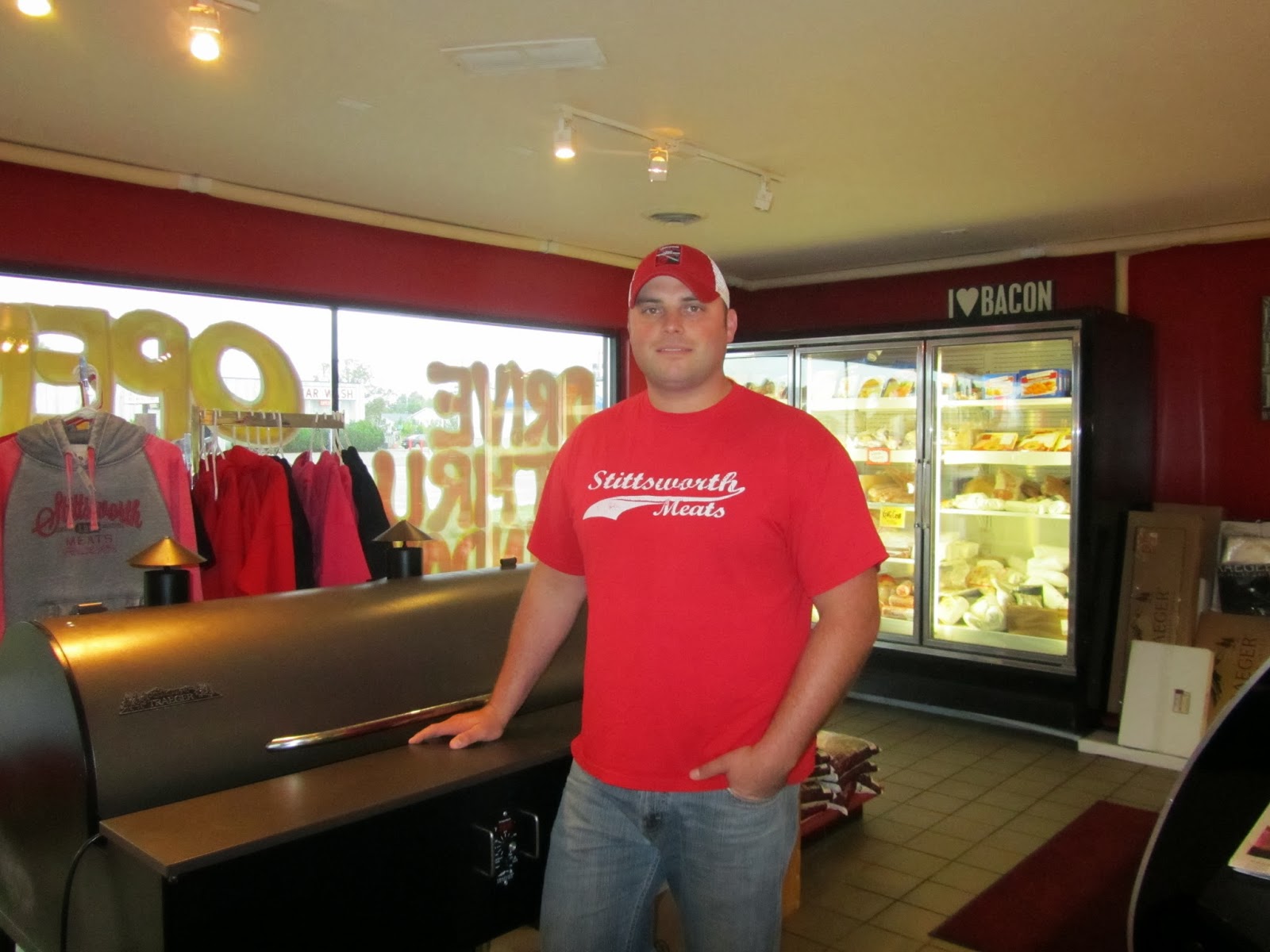
When you think of a business that really uses broadband technology, you probably don’t think about a meat market. Think again. The Stittsworth Meats Facebook page has landed in the top one percent of businesses in the United States for the largest number of Facebook followers (in the private business category).
Mike Stittsworth bought the business from his father three years ago.  At that time, it was located in a spot that was “off the beaten path,” and Mike decided to try using Facebook to get more people in the door.
Mike credits Facebook with making a huge impact on the business, saying that he believes it is directly responsible for 50% growth of the growth he’s seen.  The number of Stittsworth Meats’ Facebook followers has grown to a whopping 10,977 (as of this writing), the largest number of followers of any business or organization in Bemidji. Thanks to the viral nature of social media, the actual number of people who see his posts in their newsfeed is as high as 180,000 people.
The largest impact that Facebook has had on Stittsworth Meats is an increase in the number of customers, with daily walk-in traffic tripling since the business started using it.  The number of Facebook followers really started to grow when Mike offered his customers a chance to compete for a $200 Stittsworth Meats gift card. The winner was the one who shared the Stittsworth Meats Facebook page the largest number of times with their friends. The competition created a lot of buzz, regularly driving customers in the door to ask who was winning.
One of Mike’s secrets is that he doesn’t use Facebook to sell things.  “I just post pictures of stuff that looks or sounds impressive,” he said.  “I think that’s been good because people don’t feel like I’m pushing stuff on them.” 
Mike feels it’s important for business people to put themselves in the shoes of their customers.  If a customer is continually bombarded by repetitive posts, or feels that a business is constantly trying to sell them something, they might not want to see that business in their Facebook timeline. That’s not to say that Mike doesn’t post to Facebook very often.   According to Mike, he posts “frequently, sometimes two to five times per day.”
Mike believes that customer interaction is one of the most important aspects of a successful Facebook strategy.  “The more you can get people writing back to you—that’s the key” he said, “getting people to interact with you, rather than just pumping information out.”
Stittsworth Meats has been in the family since 1993 when Mike’s father and uncle purchased the Nymore Food Mart which had been in operation since 1899.  Their goal was to create an “old-fashioned meat market,” focusing on high quality cuts of meat, including steaks, roasts, ham, deli meats, cheese, and homemade smoked sausages and meats. 
Mike and his wife purchased the business in 2010, with a desire to continue the old-fashioned meat market traditions while looking for new ways to grow the business. 
The concept of family is one that Mike places a great deal of value on—even through his Facebook communications with customers. “There’s a ton of interaction through Facebook,” Mike said. “It’s almost like an extended family business...our customers are part of the family.”


Monday, February 24, 2014

Ada Business, Weave Got Maille, Uses Broadband Tools to Grow Business

In less than two years of being in business, Edie Ramstad has established customers in 56 countries for her rapidly growing manufacturing business, Weave Got Maille.

“We wouldn’t be where we are without broadband,” Edie said.

Her jewelry supply manufacturing facility is located on the outskirts of Ada, population 1,707, next to corn and soybean fields. 

She came to the community in 2011 when she married a local farmer, leaving behind a bricks-and-mortar store in South Dakota.

With the spirit of a true entrepreneur, and a desire to create jobs for local people, Edie decided to launch a manufacturing business in Ada.  She did her due diligence, wrote a business plan, opened her business, and began production in January, 2012. Little did she know that she would quickly blow her plan’s projections out of the water. “Within just six weeks,” Edie said, “we surpassed the fifth-year goal from our business plan.”

Many entrepreneurs fall into the trap of believing simply that “if I build it, they will come.” Edie took a different path, leaving nothing to chance or circumstance and exemplifying best practices in E-commerce.  Chief among her strategies are a commitment to keeping her website fresh and current, and capitalizing on the power of social media marketing. Edie emphasizes the importance of her business website, stating that “without a doubt, it has provided the most value” of all the broadband tools they have used.  The Weave Got Maille website has helped build an international customer base that simply would not have been possible using traditional sales and marketing methods.

The tool that has provided the second greatest impact on her business has been Facebook.  Through Facebook, she has been able to reach further and deeper. The business has done a couple of movie sets, Jersey Boys (a Broadway show) and is currently  doing some work for Game of Thrones (an HBO television drama). Social media has played a large role in making these connections with the entertainment industry.  According to Edie, “it starts with somebody seeing something they like, asking ‘where did you find that,’ and on it goes.”  An example is Jersey Boys, which is using Weave Got Maille kits for its jewelry. The show found the kits on Facebook, where a cast member saw it on a friend’s Facebook timeline.

Her business has established a niche market for itself and has quickly become the premier manufacturer and supplier of jewelry-making supplies in the United States and 55 other countries.  Edie believes that she has been able to achieve this scope due to the quality and the vast array of colors Weave Got Maille produces.  While her supplies can be used by anyone who makes jewelry, her focus is on the chain maille industry, producing supplies for custom creations, fine jewelry, renaissance jewelry, and the film industry. 

Her products start out as plain wire on spools.  It then goes through several processes—coloring, coiling, cutting, sorting, and packaging.  The final products are high-quality jump rings in a rainbow of colors.  She sells the jump rings in packages.  In addition, she sells a variety of jewelry findings in a choice of metals (copper, niobium, or sterling silver) and kits that include everything needed to make a specific piece of jewelry.

Weave Got Maille currently employs twelve people. In addition to the twelve employees, the company contracts a web designer and has plans to contract a part-time social media director in the near future. In describing the impact that broadband has had on her business, Edie said that it had increased the scope of her market, helped gain more customers, increased her profits, and made her business more efficient.  She also stated that it has led to the creation of more jobs in her community.

Other broadband tools that have provided value to her business include: Wrike, a cloud-based project management software; Constant Contact, an online email marketing tool; and Endicia, a cloud-based shipping software that processes shipping labels and integrates seamlessly with QuickBooks.

Edie is a strong proponent for broadband.  “Without the broadband spectrum, we couldn’t do this in Ada,” she said. “Broadband has enabled me to live here—where I want to live—and have an international business.”


Note:  This piece has been excerpted from a recently released study of business broadband use in northwest Minnesota.  Click here for a copy of the full study.

Wednesday, February 19, 2014

IMPACT 20/20 Releases Study on Business Broadband Use

IMPACT 20/20 Business Broadband Study

The IMPACT 20/20 Taskforce for Broadband and the Northwest Minnesota Foundation recently released a study on business broadband use within northwest Minnesota.
There were two reasons the study was seen as important: (1) the taskforce wanted a better understanding of the role broadband is currently playing among the region's businesses; and (2) they wanted to identify best practices currently being used, and subsequently, to share those best practices with the broader business community.
In sharing the information, the hope of the taskforce is that individual businesses within the region will be inspired to try new methods that others have found to be effective and that policy makers will be reminded of the important role broadband plays in northwest Minnesota's rural economy. Read more...

Friday, November 1, 2013

Minnesota Businesses Earn $38 Billion Annually in Online Sales

ST. PAUL, MN – Connect Minnesota today released the results from its new 2013 Business Technology Assessment that measures how businesses in Minnesota are using technology, and its potential for maximizing revenue opportunities and sustaining economic vitality in the state.
Among the key findings:
  • 24% of Minnesota businesses, or more than 34,000 businesses statewide, do not use broadband service, down from 27% in 2011
  • 30% of all Minnesota businesses allow their employees to telework
  • More than one in three Minnesota businesses (38%) earn revenue from online sales, and
  • Statewide, online sales account for $38 billion in business revenue annually
Broadband adoption and use is a vital component to keep Minnesota businesses – and our state’s economy as a whole – growing and competitive,” said Connect Minnesota Program Manager Bill Hoffman. “As more businesses adopt high-speed Internet service, the benefits of the technology will be leveraged to increase revenues, streamline operational costs, and allow greater flexibility for employers and employees. We must, however, be sure that our workforce is adequately skilled to compete in an global economy where technology is ubiquitous; and our data show that close to 40% of  Minnesota businesses are struggling to find employees adequately trained in the use of various technological applications.”

The report is based on a telephone survey of 801 business establishments across the state. Connect Minnesota invites you to explore and examine the survey results by clicking the link here and, most importantly, share the results.

Wednesday, September 25, 2013

IMPACT 20/20 Taskforce for Broadband Conducting Business Study

The IMPACT 20/20 Taskforce for Broadband is in the process of studying the best practices of a handful of highly successful businesses in the northwest region of Minnesota.

Taskforce members hand selected a variety of businesses that had - in some way - demonstrated success in their implementation and use of broadband.

Plans are to release the full report before the end of the year.  Early findings indicate that the use of broadband and the many tools it affords, has had an enormous impact on business success, including increasing scope of market, gaining more customers, increasing profits, and increasing efficiency.

Stay tuned...

Wednesday, January 16, 2013

Rural Broadband Policy Group Highlights


The Rural Broadband Policy Group is a growing national coalition of rural broadband advocates that emerged from the 2008 convening of the National Rural Assembly. This coalition recognizes the need for improved access and use of broadband in rural America, and it is working with policy makers, advocates, and local leaders to promote solutions.
The goals of the Rural Broadband Policy Group are:
  1. To articulate national broadband policies that provide opportunities for rural communities to participate fully in the nation's democracy, economy, culture, and society. 
  2. And to spark national collaboration among rural broadband advocates. 
Here is a brief recap of highlights and  of a few of their activities in 2012 and a look at what is underway for 2013, as reported in a recent e-newsletter:

  •  RVCC Rural Broadband Tales -- Collected stories from Conservation and Natural Resources Practitioners about why they need high-speed Internet and the challenges they face in getting access. Watch the video stories here. 
  •  Victory against Telephone Deregulation -- They expanded their state-level advocacy and got serious about making sure that powerful telcos did not cut rural people's phone lines. Working in collaboration with a broad coalition of dozens of consumers, low-income, elderly, and rural advocates including AARP, The Utility Reform Network (TURN) and Communications Workers of America (CWA), they engaged in extensive efforts across several states to defeat telephone deregulation bills. They defeated the harmful bills proposed in Kentucky and Ohio.
  •  Blogging It Up! -- Rural Strategies' Summer Intern took it upon himself to share with his opinion about the value of a rural phone landline. Read blog here. Also, in collaboration with Media Literacy Project, they deconstructed a misleading AT&T add claiming they were serving rural Texas. Read here!
  • True to our Rural Broadband Principle of prioritizing "Local Ownership and Investment in Community" they submitted comments to the California Public Utilities Commission encouraging them to open up the $50 million allocated in the California Advanced Services Fund to non-profits, municipalities, community organizations, co-ops, and local entities that can provide services to unserved areas and create local economic opportunities in rural.
For 2013, they are already planning webinars about the Impact of Telephone & Internet Deregulation on Rural Communities, comments to file at the FCC regarding AT&T's request to abandon rural telephone service, and more blogs about rural telehealth, the Internet & Conservation efforts, and what safety in an unreliable wireless world means for rural areas (especially when a natural disaster strikes). 

Monday, November 5, 2012

Governor's Taskforce on Broadband Releases Report and Recommendations

On September 14, 2012, the Governor's Task Force on Broadband released "Status Report and Policy Recommendations."  One of the State's goals is that "Universal access and high speed deployment as soon as possible, but no later than 2015 all state residents and businesses have access to broadband service that provides a minimum download speed of ten to twenty megabits per second and minimum upload speed of five to ten megabits per second."  

According to the report, very modest gains have been made in the last year. In October 2011, 57.4% of households had available broadband within the target speed range.  In April 2012, the percentage had increased to 59.92%.

The report contains a map showing  broadband service availability throughout the state, as well several recommendations.  Read more....

Wednesday, March 28, 2012

Rural and Wireless. Problem Solved?

Earlier earlier this month, Verizon announced its HomeFusion product, offering rural wireless Internet access faster than many urban residents have today and riding on the company's expanding 4G network. Is wireless the solution for connecting rural areas in Minnesota?  The answer is complicated.  Read more...

Friday, March 9, 2012

High-Speed Broadband and Agribusiness

Access to high-speed broadband is a critical component of the rural economy.

In 1910 “rural” was defined as “open countryside and any place with fewer than 2,500 people.”  The 2010 Census defined “urbanized areas” as places consisting of 50,000 or more people, and “urban clusters” as areas populated by at least 2,500 and less than 50,000 people.  Anything under that threshold is “rural.”

Ask the average person what they think of when they hear the word “rural” and they will tell you that they think of farms and farming, not population.  The idea of farming is often romanticized – evoking images of amber waves of grain, cows contentedly munching grass, and a lazily turning windmill.

While amber waves of grain still ripen in the fields and cows still graze on grass, today’s farm is a fast-paced, high-stakes business, not to mention one of the riskiest business endeavors that can be undertaken. Farmers need to use every tool in their arsenal to ensure that their bottom line is where it needs to be.

These days, one of the most critical tools for a farmer is high-speed broadband.  Most farmers are using broadband on a regular basis for their day-to-day operations.  On a typical day, a farmer might email a spreadsheet detailing crop statistics to his crop consultant, check the grain markets, do some commodities trading, download an equipment parts manual from the internet, and participate in an online auction to purchase a piece of machinery on the other side of the country.

And it’s not only farmers who need and benefit from high-speed broadband.  When one considers all the agribusinesses that support farming (and that farming supports), the need for, and resulting benefit of, high-speed access is enormous.  Agribusinesses include equipment dealers, equipment manufacturers, elevators, seed companies, fertilizer companies, trucking companies, crop sprayers, crop consultants, welding shops, tool and hardware stores, fuel companies, and food processors.

Titan Machinery is a prime example of the importance of broadband in rural areas, with 91 equipment stores and revenue of $1.3 billion.  These stores are scattered throughout a two-state area – most of them in rural communities.  High-speed broadband not only gives Titan staff the ability to communicate from store to store, it also gives them the ability to communicate with producers out in the field – in what are often very remote areas.  Imagine the following scenario:  a farmer is harvesting a high-value crop, but his combine breaks down.   With a crop that is dead-ripe and variable weather conditions that have the potential to harm it, every hour lost is costly.  With a wireless broadband connection, the producer can use his cell phone to take a picture of the broken part, attach it to an email, and send it to Titan instead of driving all the way to the repair shop and back.  The time savings can make a dramatic difference.  

Consider Border State Bank, a $25 million business, with banks in seven locations and a $350 million portfolio.  The bank relies heavily on broadband for its day-to-day operations, doing everything its urban counterparts do.  But some things are unique to a rural bank and will never be part of an urban bank’s business plan – things like having a banker who processes loans out of his tractor and pick-up truck while actively farming. This is precisely what Erik Heggedal, Ag Loan Banker for Border State Bank, did for a three-year stint.   

Consider the Fosston Tri-Coop Elevator, located in Fosston, MN, population 1,594 – a small town elevator with annual sales of $28 million.  Four years ago, they launched a website that offered a broad spectrum of marketing services, enabling farmers to market grain and virtually any commodity, and access international markets in real time.  The first day they launched the service they had about 600 hits on the website, and they continue to see hundreds of hits each day.  With wireless web access, a farmer can literally sell grain from the seat of his tractor.  

The challenge is that not all areas have adequate broadband service.  Many areas have less than adequate speed, while some have no service at all. In fact, within the 12-county area of Minnesota (defined as Economic Development Regions I and II) over 3,600 households are without any connection.

Rural areas are high-cost in terms of building out broadband infrastructure, but the risk is low in terms of the reward; this truly is an “if you build it, they will come” scenario.  The region needs to expand its current technology capabilities to allow for producer expansion, attraction of new agribusinesses, and retention of our current businesses.  This needs to be the mission of all of Minnesota as well as those who serve rural areas.

A small group of individuals, members of the IMPACT 20/20 Taskforce for Broadband, have decided to get serious about promoting adequate broadband speeds in Northwest Minnesota and eastern North Dakota.  Taskforce members believe that high-speed broadband is one of the most important components of the rural economy, now and into the future. 

The taskforce has set two goals: (1) all communities in the region of 500 residents or more will have business-grade broadband access of speeds greater than 20/10 (20 Mb download and 10 Mb upload) within five years; and (2) all residents of the region will have access to broadband speeds of 10/5 (10Mb download and 5 Mb upload) within the same time period. 

One of the main strategies of the IMPACT 20/20 Taskforce for Broadband has been reform of the Universal Service Fund (USF).  The taskforce submitted a reply comment to the FCC’s Notice of Proposed Rulemaking late last spring, voicing their support for USF reform and emphasizing the importance of high-speed Internet access in rural areas.  On October 27, in the most significant policy step ever taken to connect all Americans to high-speed Internet, wherever they live, the FCC voted unanimously to comprehensively reform its Universal Service Fund and intercarrier compensation systems.  This is an important first step in expanding high-speed Internet access in high-cost rural areas.

For more information about IMPACT 20/20, visit www.impact2020.org.
Submitted by Mike St. Onge, Regional Manager for Titan Machinery and Michelle Landsverk, agricultural producer and President of Landsverk and Associates.  Mike is a member of the IMPACT 20/20 Taskforce for Broadband and Michelle is project coordinator for the initiative.

Monday, November 7, 2011

Governor Dayton Names Broadband Taskforce Members

Just this morning, Governor Dayton announced the formation of a task force on Broadband.  The task force is charged with developing policies to promote the expansion of broadband access in Minnesota. Dayton’s stated goal is “border-to-border” high-speed Internet and cell-phone access throughout Minnesota.


IMPACT 20/20 member, Dick Sjoberg, will serve on the Governor's task force, along with 14 others. 


Read more...

Thursday, October 27, 2011

FCC Shifts Subsidy Fund to Broadband


(Reuters) - Regulators agreed on Thursday to change an $8 billion national communications subsidy program to put more emphasis on providing high-speed Internet access to rural areas.
The Federal Communications Commission voted unanimously to shift roughly $4.5 billion spent annually to subsidize rural telephone service over to providing broadband in rural and costly-to-serve areas.

Read more...

Saturday, October 15, 2011

"Bringing Broadband Infrastructure to Rural Areas: Where is the Progress?"


, Deputy Editor, BroadbandBreakfast.com

Thursday October 13th 2011 – As BroadbandBreakfast.com gears up for our panel on“Bringing Broadband Infrastructure to Rural Areas: Where is the Progress?” we have been taking some notes on the FCC’s efforts to reform the Universal Service Fund and listened in on Wednesday’s Senate Commerce Hearing on “Universal Service Reform – Bringing Broadband to All Americans.” Here is a summary of some of the talking points and some highlights from the hearing. 

Read the article...

Monday, October 10, 2011

FCC Chairman Unveils Broadband Plan


Federal Communications Commission Chairman Julius Genachowski on Thursday unveiled a plan that he said will help bring broadband service to the 18 million Americans who are currently without access.
Specifically, the plan would revamp the Universal Service Fund (USF) to include broadband. The USF is a government fund created in 1997 intended to provide all Americans with access to telecom services, as well as Internet service in schools and libraries.  Read the full article...

Monday, September 26, 2011

USDA Awards Funding for High-Speed Broadband Installation in Park Rapids Area

Paul Bunyan Communications has been granted a $17 million loan through the USDA’s Rural Utility Service broadband loan program. The funding award means that 4,000 homes and businesses in the Park Rapids area will have high-speed broadband access!
Read the full article.